
Water Bottle Rack Supplier Evaluation: Sample-to-Bulk Trace
A water bottle rack order is only as dependable as the specification behind it. For an OEM program with custom dimensions, supplier evaluation should answer one question before price is discussed: can this supplier reproduce, in bulk and with records, the exact rack that was approved as a sample?
This guide sets out a traceability framework for importers, distributors, private-label brands and water delivery companies evaluating 5-gallon water bottle rack suppliers. It follows the specification from the sample stage through in-production inspection to the pre-shipment check, and shows which evidence to demand at each step: tube and wire specification, electrostatic powder spraying versus chrome plating, assembled versus knocked-down supply, load and structural stability checks, spigot compatibility, and the freight consequences of foldable or detachable designs.
SHAFON Water Solutions (Ningbo SHAFON Import & Export Co., Ltd.) is a China-based B2B supplier of water dispensing and storage products — 5-gallon water bottle racks, water buckets, non-electric dispensers, faucets, caps and accessories — established in 2015 and exporting to more than 30 countries. Its published rack range, including the vertical SF-BR-11A and the tabletop SF-BR-09A, is used below as a worked example of what a traceable specification looks like; the values quoted are the supplier's stated baselines, and the approved drawing for your own SKU always governs.
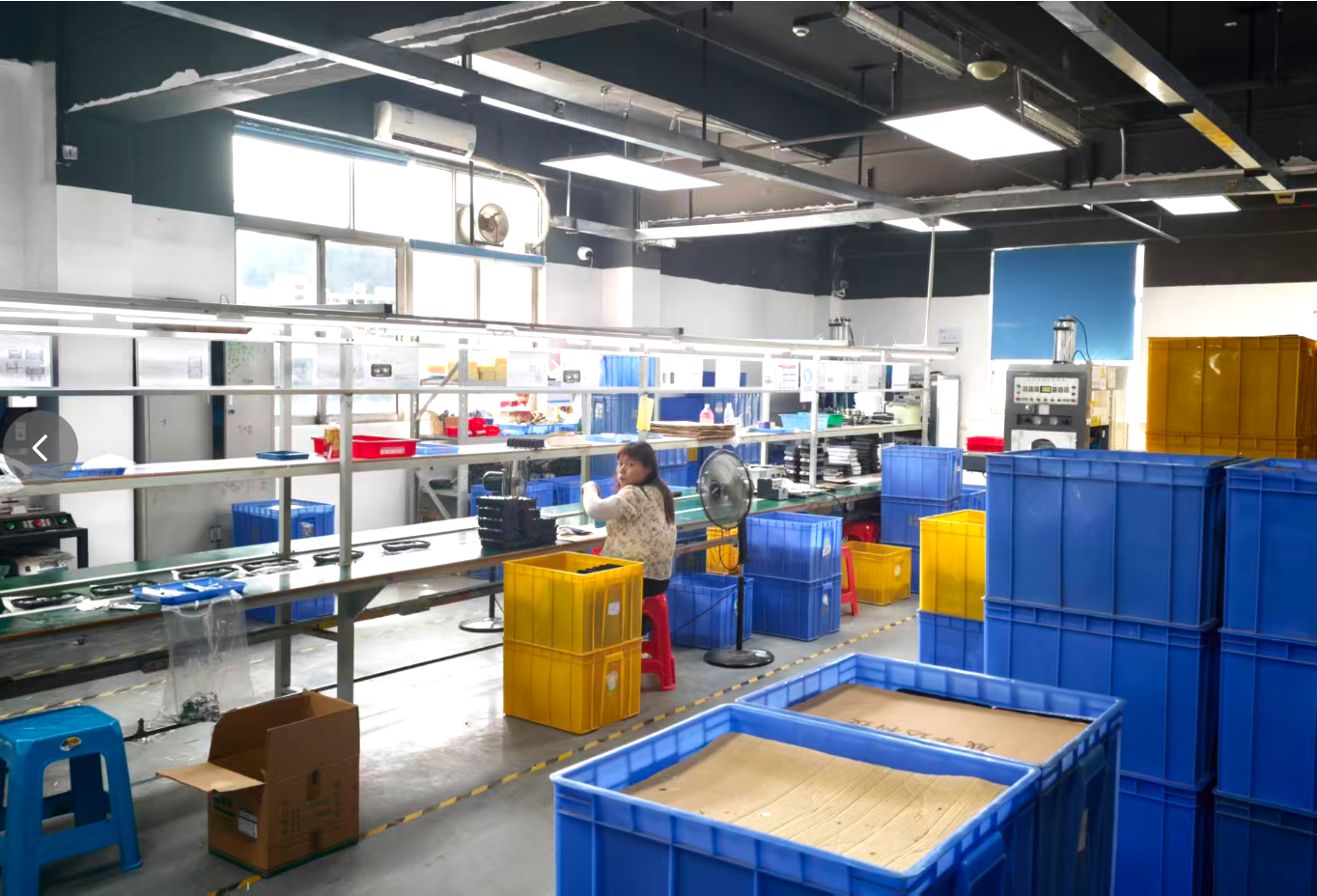
Assembly Workshop. Assembly checks form part of the stated inspection sequence before shipment.
Why the sample-to-shipment chain breaks
Most rack sourcing problems are not dramatic failures. They are small, cheap deviations that a photograph cannot reveal: a 0.6 mm tube wall where the sample used 0.8 mm; wire one gauge thinner; coating that is thin on the inside of a bend; two welds fewer on a base joint; a carton that holds 24 sets instead of the agreed 30. Each deviation reduces material cost and each one is invisible until a customer complains, a rack wobbles, or freight per set quietly rises.
That is why piece price is a poor first question. Two quotations can sit 10% apart while describing different products, different packaging volumes and different inspection discipline. The productive sequence is to fix the specification, then compare what each supplier can prove against it.
A traceable rack order has four links, and every one of them can be documented:
- An approved dimensioned drawing that describes the custom rack — overall height and width, tier pitch, bottle pocket, base footprint, member sizes.
- A material and finish specification — steel grade, tube wall thickness, wire specification, coating system and colour.
- Inspection records taken in production and before shipment, tied to that specification.
- A packaging plan — sets per carton, carton dimensions, marks and loading method.
When a supplier cannot produce all four on request, the quotation is not yet comparable, and a first bulk order becomes an experiment.
Five capability layers behind an OEM rack quote
For a water bottle rack, “capability” is not a single claim about machinery. It is the ability to control five separate layers, each with its own evidence. Buyers evaluating an OEM 5-gallon rack manufacturer with custom dimensions should test the layers in this order.
| Capability layer | Evidence to request before the PO | What goes wrong if it stays verbal |
|---|---|---|
| Dimensional engineering | Dimensioned drawing with tolerances; confirmation the sample was made to that drawing, not adjusted by hand | Bulk racks fit the sample but not the customer's storage bay or bottle |
| Material control | Steel grade and tube wall thickness per member; wire specification | Thinner wall or wire substituted at material intake |
| Finish control | Coating system, colour standard and a physical reference sample | Colour drift, thin coverage, early rust at welds |
| Inspection and records | In-production inspection plus pre-shipment inspection, and the format records are delivered in | Defects discovered by the buyer at destination |
| Packaging and freight engineering | Sets per carton, carton dimensions, gross weight, marks, loading pattern | Freight per set higher than quoted; carton damage in transit |
A sixth layer matters for water-station buyers: accessory integration. A rack program can be shipped together with matching PP faucets, bottle caps and bottle bases in one order, which simplifies sourcing and freight. If the rack is intended to carry a bottle with a side spigot, that interface has to be specified at drawing stage rather than discovered at assembly.
Build the spec sheet you will trace
The table below summarises the specification baseline that SHAFON publishes for its metal rack range. Use it as a checklist of what a quotation should state explicitly, not as a substitute for the drawing approved for your order.
| Specification element | Documented baseline | What the bulk order must repeat |
|---|---|---|
| Frame tube | Q195 / Q235 steel tube; 20 × 20 × 0.6–0.8 mm and 16 × 0.8 mm tube formats | Same grade and same wall thickness on every member, including the base |
| Wire elements | Steel wire, chrome-plated where specified | Wire diameter and plating consistent with the approved sample |
| Surface finish | Electrostatic powder coating in black, white or silver grey; chrome plating as an alternative | Colour matched to a physical standard; no rust, no scratches |
| Structure type | Foldable, one-piece, raised, tabletop, vertical or multi-tier | Same structure; no silent redesign between sample and bulk |
| Load reference | Product drawings and loading references available on request | The same reference supplied for the bulk configuration |
| Spigot and accessories | PP faucet with food-grade PP body and food-grade silicone sealing rings; caps and bases can ship in the same order | Seat fit and faucet assembly checked before shipment |
| Packing | Foldable: flat packed in OPP bag or paper card, about 30 sets per carton. One-piece: assembled, in individual boxes | Sets per carton, carton dimensions, marks confirmed per order |
| MOQ and lead time | 200–300 pcs (one-stop supply), 500 pcs (OEM, 15 days), 1,000 pcs (ODM, 30 days) | Confirmed against your actual configuration, not the catalogue average |
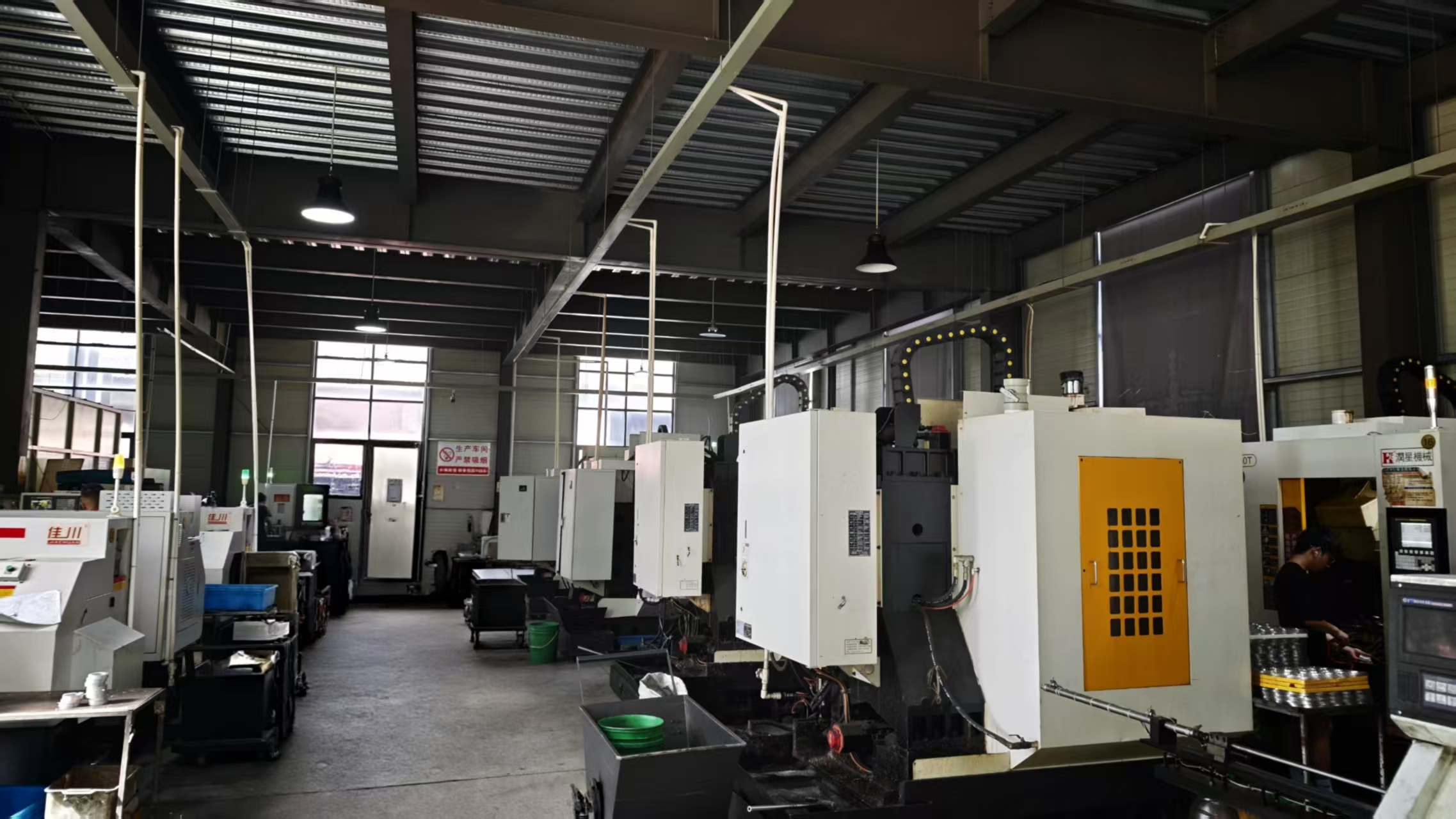
CNC Workshop. Dimensional control starts upstream of assembly.
Sample stage: turn one rack into a controlled reference
A sample is only useful as a reference if it is measured, recorded and sealed. A rack that arrives, is photographed once and then given to a colleague is an impression, not a specification.
SHAFON's stated OEM intake asks the buyer for product type, quantity, target market, rack colour, logo, packaging requirement and any specific dimensions, and confirms drawings and samples before bulk production. That sequence is the right shape for any supplier evaluation, and it can be tightened with seven measurement steps:
- Write the brief in numbers, not adjectives. Bottle envelope (diameter and height), number of tiers, target overall height and width, base footprint, colour, finish, logo position, packaging format and destination market.
- Get a dimensioned drawing before the physical sample. If the drawing and the sample disagree, the drawing is corrected and the sample remade — not the other way round.
- Measure the frame with a caliper. Record tube outside dimension and wall thickness at the end, middle and bend of each member type; record wire diameter on load-bearing elements. Wall thickness is the single most common silent substitution in rack manufacturing.
- Record the geometry. Base width, tier pitch, pocket opening, overall height, and a diagonal check to confirm the frame is square rather than racked.
- Inspect the finish against a physical standard. Keep a coated reference plate or the approved sample itself; check coverage inside bends and around welds, and confirm the coating system matches the quotation — powder-coated tube is the most common choice for commercial and water-station racks, while chrome plating is used where a bright metallic appearance is wanted.
- Check welds and assembly. Weld integrity, no sharp edges, and — if a faucet is included — actual assembly and a leak check on the bottle the rack will hold.
- Sign and seal the golden sample. Keep it with the signed spec sheet and the drawing. It is the physical standard against which bulk inspection is carried out.
Ask for the load reference at this stage, not later. Tube and wire diameter, wall thickness, weld quality, base width and tier count are the variables that drive capacity and stability; a supplier who can share drawings and loading references during sampling can normally share inspection records during production.
Where bulk drifts from the sample — and the QC points that catch it
Bulk orders rarely diverge from a sample at the design level; they diverge at material intake and at packing. That makes the inspection plan a short, specific list rather than a general statement of quality.
| Check point | What “good” looks like | Stage |
|---|---|---|
| Quantity | Counted against the order and the packing list, per model and per carton | Pre-shipment |
| Tube and wire specification | Wall thickness and wire diameter within the tolerance on the approved drawing | In-production and pre-shipment |
| Weld integrity | Complete joints, no burn-through, no sharp edges at handling points | In-production and pre-shipment |
| Surface finish | No rust, no scratches, colour consistent with the approved standard | Pre-shipment |
| Faucet assembly | Correct faucet fitted, seated properly, no leakage at the joint | Pre-shipment |
| Packaging and shipping marks | Carton specification, sets per carton and marks matching the confirmed plan | Pre-shipment |
The important structural point is that wall thickness is a material-intake variable, not a final-inspection one. If the only inspection happens after packing, a substituted tube spec is already inside a sealed carton. Buyers placing a first order with a new supplier should therefore agree an in-production visit or third-party check at the material and welding stage, and a pre-shipment check before loading. Per-order packaging confirmation closes the third common gap: bulk that matches the sample in every respect except the carton.
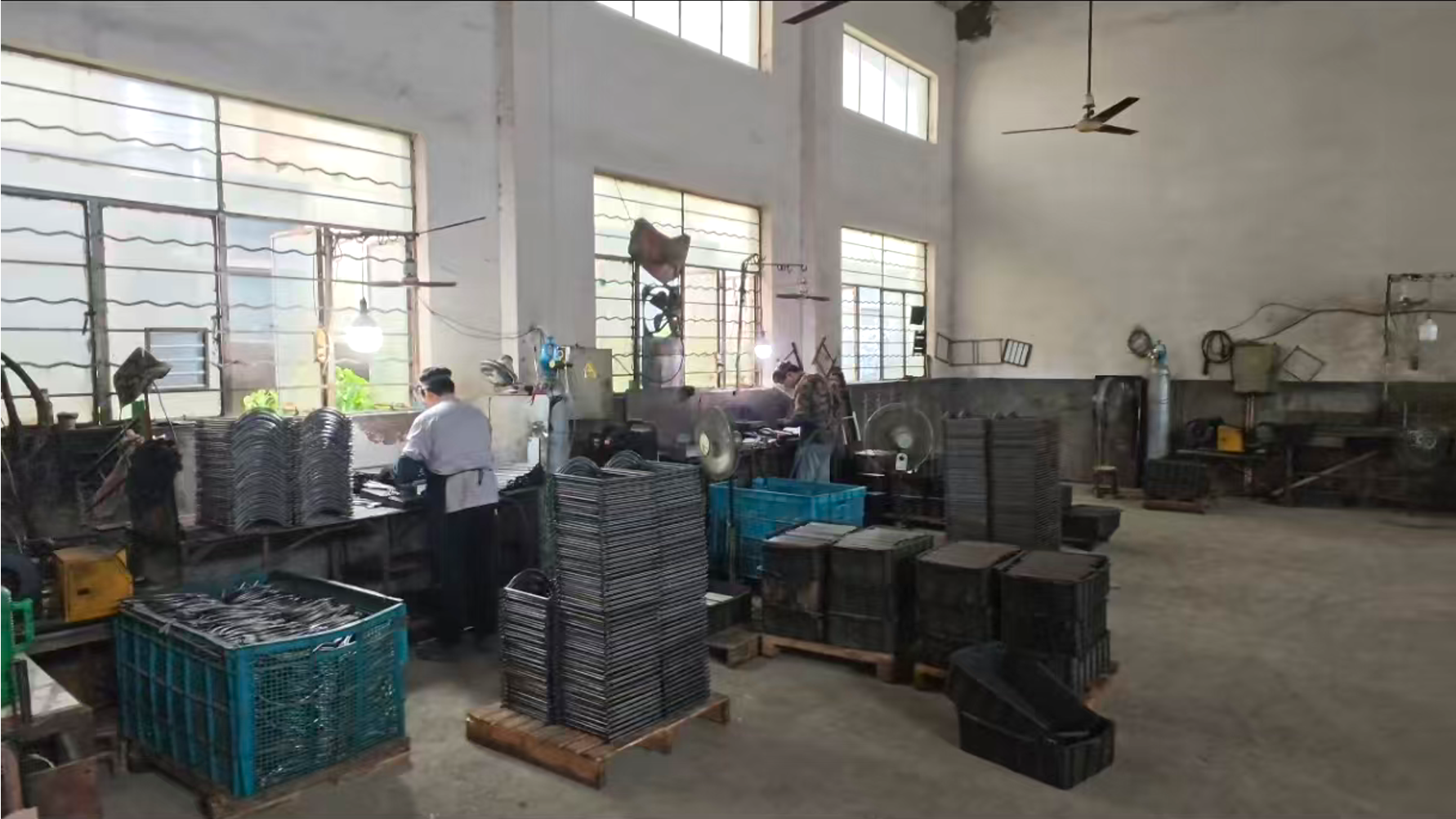
Welding Workshop. Weld integrity is a stated inspection point in both in-production and pre-shipment checks.
Load capacity and structural stability: what can actually be verified
Load capacity is where supplier claims and buyer evidence most often separate. A full 5-gallon jug weighs roughly 42–45 lb (about 19–20 kg) according to buying guidance published for this product category, so a multi-tier rack is being asked to hold a substantial static load, repeated every time it is reloaded.
Four documented variables drive that performance: tube and wire diameter, wall thickness, weld quality, and base width together with tier count. A fifth, practical variable is how the rack is loaded — bottles placed on the top tier of a tall frame behave differently from bottles distributed across the base.
Public product information in this category is uneven, which is why claims need scoping rather than comparison:
- A US wire-rack manufacturer describes three- and six-bottle stands as lightweight and collapsible, and twelve- and twenty-four-bottle racks as rugged units for high-volume facilities — capacity and configuration are published, wall thickness and coating specification are not.
- Steel storage-rack listings commonly publish bottle capacity and post diameter, for example 1-inch steel posts with welded wire shelves across four to sixteen bottle configurations — but not tube wall thickness or a load-test method.
- Transport-oriented rack suppliers describe carbon-steel rectangular pipe construction for moving and stacking barrelled water — again without a verified load rating.
- Marketplace listings can claim figures such as “over 500 lb” for a twelve-bottle, four-tier rack while publishing no test method, safety factor or dimensions. Such a number cannot be used as a benchmark against another supplier's product.
The practical consequence for a buyer is that load capacity has to be verified on your own configuration. Agree a simple static protocol with the supplier: load the specified number of filled bottles, or an equivalent dead weight, on the most heavily loaded tier; hold it for an agreed period; observe deflection, base movement and weld condition; photograph the result. Run the same protocol on the sample and on a unit pulled from bulk production. This does not create a certified rating, but it does expose the difference between a sample built to drawing and a bulk unit built to a price.
Powder coating or chrome plating
Electrostatic powder coating offers broad colour options and good surface protection when it is properly applied; chrome plating gives a bright metallic appearance. Corrosion performance for either finish depends on substrate preparation, coating or plating quality, thickness and the service environment — not on the finish name alone.
Three specification habits prevent most finish disputes. First, state the system and the colour code rather than “black”. Second, keep a physical colour standard, because a photograph under warehouse lighting is not a reference. Third, add “no rust, no scratches” to the pre-shipment check, since finish defects are the easiest defect to catch and the most visible to your own customer. Powder-coated steel tube is the most common choice for commercial and water-station racks in this product family; chrome-plated wire appears where the design calls for it. Do not compare a powder-coated sample against a chrome-plated quotation as if they were the same offer.
Assembled or knocked down: packaging, freight and stability
Structure choice changes freight more than most buyers expect. Foldable racks pack flat — in OPP bag or paper card packaging — at roughly 30 sets per carton and, on SHAFON's stated figures, occupy about 60–70% less shipping volume than one-piece racks, which significantly reduces ocean freight per set. One-piece racks ship assembled in individual boxes.
That creates a genuine trade-off rather than a single right answer: foldable racks save shipping and storage space, while one-piece fixed racks are more stable. For a distributor paying ocean freight on every replenishment, the volume saving usually dominates. For a fixed installation, a rental fleet that is reloaded constantly, or a retail program that needs shelf-ready presentation, the assembled format often justifies its freight.
Two checks keep this decision honest. First, ask for the carton plan in numbers — sets per carton, carton dimensions, gross weight, marks — and calculate freight per set yourself rather than per container. Second, confirm how the rack is set up on arrival, because a flat-packed rack transfers some handling to the destination warehouse.
PP spigot and accessory compatibility
Racks can be shipped together with matching PP faucets, bottle caps, bottle bases and other accessories in one order, which reduces the number of suppliers and shipments a buyer has to manage. Faucets in this range use food-grade PP with food-grade silicone sealing rings, and food-contact suitability depends on the specific material and finished product meeting the requirements of the destination market.
Compatibility is a sample-stage question, not a paperwork question. Confirm the faucet model against the bottle you will actually use, fit it to the rack-mounted bottle, and check the seat for leakage. Faucet assembly is also a stated pre-shipment check point, so it should appear on the inspection record rather than being assumed from the sample. If your rack is custom-dimensioned, specify the bottle envelope and the spigot clearance at drawing stage — a rack that fits the bottle but not the tap is still a rejected design.
Delivery assurance: MOQ, lead time and capacity
Delivery assurance in a rack program comes from three things that can be checked: published capacity, tiered MOQ and lead times by supply mode, and inspection discipline that keeps bulk consistent with the sample.
| Supply mode | MOQ | Lead time | Customization scope |
|---|---|---|---|
| One-stop supply | 200–300 pcs | In stock, ships within 5 days | Water buckets + racks + faucets + accessories in one program |
| OEM | 500 pcs | 15 days | Logo, colour, packaging, product matching |
| ODM | 1,000 pcs | 30 days | Product development, structure and appearance design, market-specific requirements |
SHAFON states monthly capacity of 20,000–30,000 water bottle racks alongside 750,000 water buckets, an annual output of 240,000 racks, a 5,000 m² facility, a team of 4–5 R&D engineers and an export share of 80–90%. Capacity figures of this kind are useful for screening a program against your forecast, but they should be read as stated capability, not as a booking guarantee for your specific delivery window.
Repeat-program evidence is more informative than a capacity number. Company-reported cases include a private-label brand ordering 2 × 40HQ per month for a year with structured product inspection, packaging confirmation and shipment preparation; a hotel and catering supplier ordering 1 × 40HQ every two months with attention to capacity, materials, packaging and spare parts details; and a water products importer ordering 1 × 40HQ per month with OEM packaging and a flexible product mix. These describe how a repeat program is run, not a promise that any new order will match those volumes or timelines.
One caution on the five-day figure: it applies to in-stock items. A rack with custom dimensions moves into the OEM or ODM path, where drawing approval, sampling and a 15- or 30-day production window apply instead.

Packaging Workshop. Carton plan, marks and sets per carton are confirmed per order.
Ten-point supplier evaluation workflow
- Brief the supplier in writing: model type, quantity, target market, colour, logo, packaging and specific dimensions.
- Request a dimensioned drawing and reconcile it with the offer, including tube and wire specification per member.
- Approve the material specification in writing: steel grade, wall thickness range, wire specification.
- Approve the finish against a physical colour and coating standard.
- Test the sample: measure wall thickness and geometry, inspect welds, run a static load check on the most loaded tier.
- Confirm spigot and accessory fit on the actual bottle, including a leak check.
- Sign the spec sheet and seal the golden sample.
- Fix the packaging plan: sets per carton, carton dimensions, marks, loading pattern.
- Agree inspection points and the record format — in-production plus pre-shipment, with photos or a report per check.
- Reconcile the first bulk shipment against points 1–9 before releasing the second order.
Matching rack formats to the application
Format selection follows from the handling pattern, not from the catalogue page. For water delivery and distribution operations where freight per set and staging space dominate, foldable models such as SF-BR-01A and SF-BR-02A and multi-tier frames with more bottle positions are the natural starting point; if mobility is required, confirm whether castors can be added under an OEM project rather than assuming a standard model includes them. For offices and small commercial areas, tabletop models (SF-BR-04A, SF-BR-06A, SF-BR-09A) and vertical models (SF-BR-11A, SF-BR-11C, SF-BR-11G) cover counter-top and floor-standing use. For home storage, foldable and raised formats keep the footprint small. For hotel, catering and private-label programs with regular container volumes, multi-tier racks (SF-BR-12A, SF-BR-17A, SF-BR-20A), the SF-BR-22A storage rack and the SF-PSB-01 storage tower give a wider format range to build a programme around.
What this framework cannot confirm
Three limits should be stated plainly, because a supplier evaluation that overstates its own reach is not a reliable one.
Company-level is not product-level. SHAFON holds ISO 9001 quality management system certification (certificate ECI25Q00869R0S, issued 25 September 2025 by Beijing Guoyouxincheng Certification Service Co., Ltd., valid to 24 September 2028) covering the wholesale of plastic products, hardware products and daily necessities including import and export — a company-level QMS, not a rack load certification. Product-specific test documents in the supplied evidence include a RoHS test verification for a water dispenser (BCTC2507407245C, Shenzhen BCTC Testing Co., Ltd., 21 July 2025) and an LFGB food-contact test report for a water bucket (EFHZ26031380-CG-01+Rev1, EUROFINS, 28 May 2026). Buyers should ask which document applies to the rack SKU and to their destination market, and treat compliance as product- and market-specific.
The producing site matters. SHAFON states that it works with qualified manufacturing partners and coordinates product development, material selection, manufacturing, quality control, packaging and export delivery. Buyers whose procurement rules require a factory audit should therefore confirm which site will produce their order, and audit that site.
No rack-specific load standard was identified. In the sources reviewed for this article, no applicable load or stability test standard specific to 5-gallon water bottle racks was found. That absence is exactly why an agreed, documented static load protocol between buyer and supplier is worth more than a headline capacity figure.
Frequently asked questions
What compliance documents should a water bottle rack buyer ask for?
Compliance requirements depend on the specific product and destination market. A supplier can normally coordinate applicable testing and documentation based on materials, function and local regulation — potentially food-contact test reports, RoHS-related testing, material reports or other product-specific documents where applicable. A company-level ISO 9001 certificate supports quality management claims but is not a product certification, so ask which report covers your rack model and market.
Can a supplier make a 5-gallon water bottle rack to my own dimensions?
Yes, under an OEM or ODM program, provided the requirements are defined before production. A workable brief includes product type, quantity, target market, rack colour, logo, packaging requirement and the specific dimensions you need; drawings and samples are then confirmed before bulk production. Custom dimensions affect tier pitch, base footprint, bottle pocket and spigot clearance, so all four belong on the drawing rather than in correspondence.
What MOQ and lead time should I expect for a custom rack order?
MOQ and lead time scale with customization. For reference, the tiers published by SHAFON are 200–300 pcs for one-stop supply with in-stock items shipping within 5 days, 500 pcs for OEM (logo, colour, packaging, product matching) at 15 days, and 1,000 pcs for ODM development at 30 days. Custom dimensions fall under the OEM or ODM path, and the clock starts after drawing and sample approval, not at inquiry.
How do I keep bulk racks consistent with the approved sample?
Consistency is built from three controls: a signed specification with a sealed golden sample, in-production inspection plus pre-shipment inspection, and per-order packaging confirmation. The pre-shipment check should cover quantity, tube and wire specification, surface finish (no rust, no scratches), weld integrity, faucet assembly and packaging with shipping marks. Because wall thickness is decided at material intake, a first order benefits from an in-production check before cartons are sealed.
How do foldable racks affect freight, and how do I start an evaluation?
Foldable racks pack flat at roughly 30 sets per carton and, on the supplier's stated figures, use about 60–70% less shipping volume than one-piece racks, which lowers ocean freight per set; one-piece racks ship assembled in individual boxes and offer a more stable fixed structure. To start a real evaluation, send the bottle envelope, tier count, target dimensions, finish, logo and packaging requirement, then ask for a dimensioned drawing, a sample and the inspection plan behind it — a sample request and quotation based on your own drawing is the fastest way to see whether a supplier's capability survives the transition to bulk.
Conclusion
Supplier evaluation for water bottle racks is a documentation exercise before it is a price negotiation. The rack that reaches your warehouse should be traceable, link by link, to the drawing you approved: the same Q195/Q235 tube at the same wall thickness, the same wire, the same powder coating or chrome plating, the same weld standard, the same faucet fit, the same carton count. A supplier that can produce that chain — and show inspection records at material intake, during production and before shipment — gives you something a lower piece price cannot: a repeatable order.
For buyers who want to work through these points on a specific configuration, SHAFON's technical and quotation documentation can be reviewed alongside the drawing discussion.
Reference document: SHAFON Water Solution quotation and product brochure (PDF).
Have Questions or Need More Details?
Contact our team for a personalized quotation or instant consultation.
Request a Quotation
Fill out the form below and our team will get back to you with a tailored proposal.
WhatsApp Direct Chat
Prefer to chat in real-time? Message us on WhatsApp for instant assistance & quick answers.
- Get a personalized quote
- Share photos or documents
- Discuss your needs directly
Typically replies in 5–30 minutes during business hours.