
When Bulk Racks Don't Match the Sample: A 5-Gallon Water Bottle Rack QC Plan
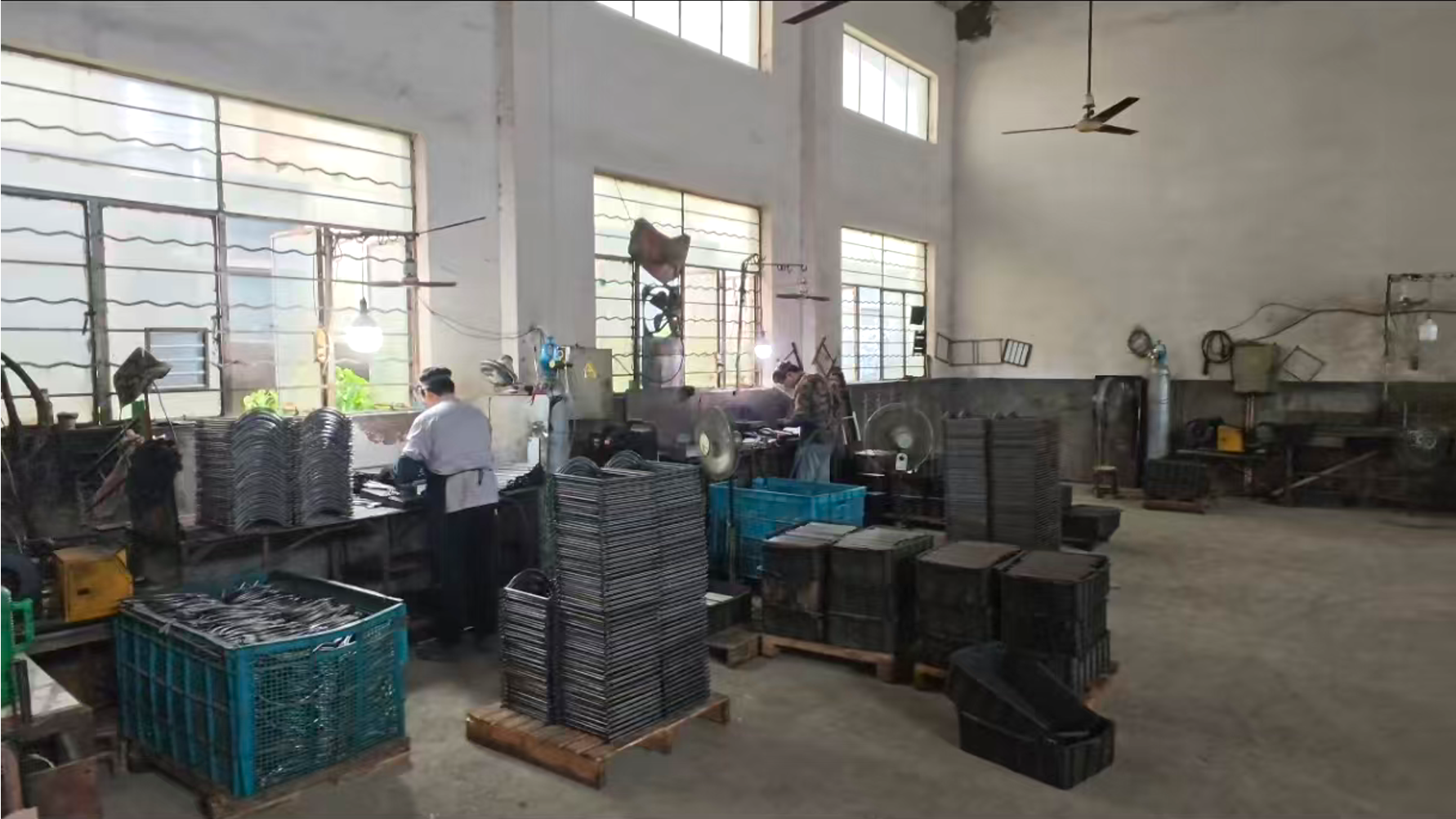
Welding Workshop — joint quality is one of the four control points in a bulk-versus-sample inspection plan.
A buyer signs off a sample 5-gallon water bottle rack after checking the tube, the surface finish and a loaded top tier. The bulk order follows. When it lands, the cartons look right at a glance — until someone measures the carton, counts the hardware inside a knocked-down set, or holds two units side by side under the same light.
This article is a pre-shipment quality control plan for that exact gap. It assumes the sample was good and asks a harder question: what evidence proves the production lot is the same product? The plan has four control points — surface finish, load and structural stability, assembly completeness, and packaging volume — plus a document check that tells you whether the certification you were shown actually covers the rack you bought. Every item below can be written into a purchase order or an inspection checklist before production starts.
An approved sample proves one unit, not the lot
A sample is a unit; a bulk order is a process. The sample carton does not normally state which tube wall thickness was used, which powder batch was sprayed, how many bolts belong in a flat-pack set, or what carton volume per unit was quoted. Those four facts are exactly what a shipment is judged on, and none of them travel automatically from the sample bench to the production line.
The practical definition is simple: a bulk-versus-sample QC plan is a written list of checkpoints, each with a measurable acceptance rule and a retained reference unit, inspected at defined stages and signed off before the order is released. Without it, a buyer is comparing a memory of the sample to an impression of the shipment.
Why a rack that matched the sample can still fail on arrival
Divergence usually enters through one of five doors, and each one is invisible in a product photograph.
- Finish batch drift. Powder coating colour and gloss shift with pigment batch, cure conditions and film thickness; chrome brightness and coverage shift with plating time, bath chemistry and current density. Both can pass a quick glance and fail a side-by-side comparison.
- Material or section substitution. Tube or wire diameter and wall thickness are the cheapest place to recover margin. A 0.6 mm wall instead of a 0.8 mm wall does not show in a photo and does change stiffness and load behaviour.
- Weld and joint variation. Tier-to-post connections, spatter, incomplete fusion and inconsistent base geometry appear as the run speeds up.
- Component completeness. On detachable and flat-pack models the rack is only half the SKU; hardware, caps and instructions decide whether the unit can be used at all.
- Packaging drift. Carton dimensions and sets per carton change freight cost per unit even when the rack itself is identical.
Each door has the same lock: an acceptance criterion agreed in writing, measured against a retained sample, recorded at pre-shipment inspection.
Industry background: what a rack is made of, and why catalogues cannot settle it
Commercial 5-gallon racks are commonly built from Q195 or Q235 steel tube with electrostatic powder coating in black, white or silver grey, from steel wire with chrome plating, or from PP plastic. Powder-coated steel tube is the most common choice for commercial and water-station use. Typical quoted sections include 16×0.8 mm wire and 20×20×0.6–0.8 mm steel tube — numbers that rarely appear on a product page.
Public listings show the vocabulary problem clearly. J&P Wire Products describes three-bottle and six-bottle wire racks as lightweight and collapsible, and lists twelve- and twenty-four-bottle racks for facilities with high-volume usage. Nexel listings describe steel racks with 1-inch diameter posts and welded wire shelves across 4, 6, 8, 12 and 16 bottle capacities. Marketplace listings advertise foldable, wheeled, three-tier jug holders in heavy-duty steel. These are supplier- or listing-reported product descriptions, not independently verified load data, and none of them shares a common measurement basis.
Commercial research published by Coherent Market Insights links category demand to urban lifestyles and growing awareness of bottled-water benefits; useful context, but it tells a buyer nothing about whether the 800 units in the container match the sample on the bench. Because the category has no shared specification language, the buyer's own checklist is often the only document that can be compared line by line between sample and shipment.
Control point 1: finish consistency
Finish is the first thing a customer notices and the last thing a factory measures. Define it as a comparison against the retained sample under fixed conditions, then add the two process questions that decide durability: substrate preparation, and the coating or plating specification.
For powder-coated racks, inspect colour and gloss against the sample, coverage at weld seams and cut ends, freedom from runs, sagging and heavy orange-peel beyond the sample, and freedom from chips that expose bare steel. For chrome-plated wire, inspect brightness uniformity, pitting, yellowing and coverage inside wire bends where current density is weakest. One boundary matters: corrosion performance for either finish depends on substrate preparation, coating or plating quality and thickness, and the service environment — so "same colour" is not the same as "same durability". Ask for the finish specification in writing rather than judging it by eye alone.
| Comparison | Powder-coated steel | Chrome-plated wire |
|---|---|---|
| Visual character | Broad colour options; matte or satin appearance | Bright metallic appearance |
| Inspect at pre-shipment | Colour and gloss vs sample, coverage at welds and cut ends, runs, chips to bare steel | Brightness uniformity, pitting, yellowing, coverage inside bends |
| Where drift shows up | Pigment batch, cure conditions, thin film at edges | Plating time, bath chemistry, current density at recesses |
| Record to keep | Photo log under fixed light, finish spec sheet | Photo log, plating spec sheet, moisture protection check |
Control point 2: load capacity and structural stability
A rack's load behaviour is set by four measurable things: tube or wire section, weld quality, base geometry and tier count. Inspect all four instead of relying on a single capacity number printed on a listing.
Measure the section first. Record outer diameter and wall thickness at agreed points on the sample and on production units using a caliper, and keep the readings. Then inspect tier-to-post welds for incomplete fusion, heavy spatter and gaps, check the base width and foot contact, and confirm the tier count against the drawing.
It helps to know the scale of load involved. A filled 5-gallon (18.9 L) bottle weighs approximately 42–45 lb (19–20 kg). A 12-bottle rack is therefore carrying roughly 500–540 lb (about 230–245 kg) of product before the rack's own weight is counted. That is a calculated figure, not a rated capacity — its purpose is to show how much weight a meaningful stability check has to represent.
Be equally careful with published ratings. A public marketplace listing for a 12-bottle stainless steel rack claims a load capacity exceeding 500 lb without stating a test method, safety factor or product dimensions; that is a claim to verify, not a benchmark to copy. If a supplier quotes a load figure, ask which method produced it. SHAFON states that product drawings and loading references can be shared on request, which is the practical substitute for a number without a method.
A static check that a buyer can run without a laboratory: load representative bottles tier by tier, place the rack on a level floor, look for rocking and foot contact, watch the joints under load, confirm the top tier is reachable in use, then unload and check for permanent deformation.
Control point 3: assembled versus knocked-down completeness
Supply form decides what completeness means. Foldable types ship flat, packed in an OPP bag or on a paper card; one-piece types ship assembled in individual boxes. Both are set up easily on arrival — which is precisely why a missing bolt is easy to discover late and expensive to fix at the destination.
Inspect hardware count per set against the bill of materials, the presence and language of the assembly instruction, the parts count per flat pack, and whether pre-assembled units include all fixed fittings. Work at carton level as well as unit level: confirm units per carton against the packing list, because an error there is only found when a customer opens the last box.
| Supply form | How it ships | Inspection focus | Freight effect |
|---|---|---|---|
| Foldable / detachable | Flat pack, OPP bag or paper card; about 30 sets per carton | Hardware count per set, parts per pack, instructions, carton dimensions | Roughly 60–70% less shipping volume than one-piece racks |
| One-piece fixed | Assembled, individual box | Weld integrity, base geometry, box protection of finished surfaces | Higher volume per unit; more protection needed in transit |
Control point 4: packaging volume for foldable designs
Foldable racks pack flat at about 30 sets per carton and roughly 60–70% less shipping volume than one-piece racks, which is where the freight saving comes from. The saving only exists, however, if the carton actually matches the plan that was quoted.
Measure carton length, width and height on a sample of cartons, count sets per carton, and calculate cubic metres per set. Compare that figure with the assumption used in the quotation. A carton that is marginally taller, or holds fewer sets, quietly raises freight per unit even when every rack inside is perfect. Finish the check with shipping marks, carton labelling, corner protection, and moisture protection for plated wire and coated surfaces that will travel in humid containers.
Certification evidence: what ISO 9001 and a RoHS verification actually cover
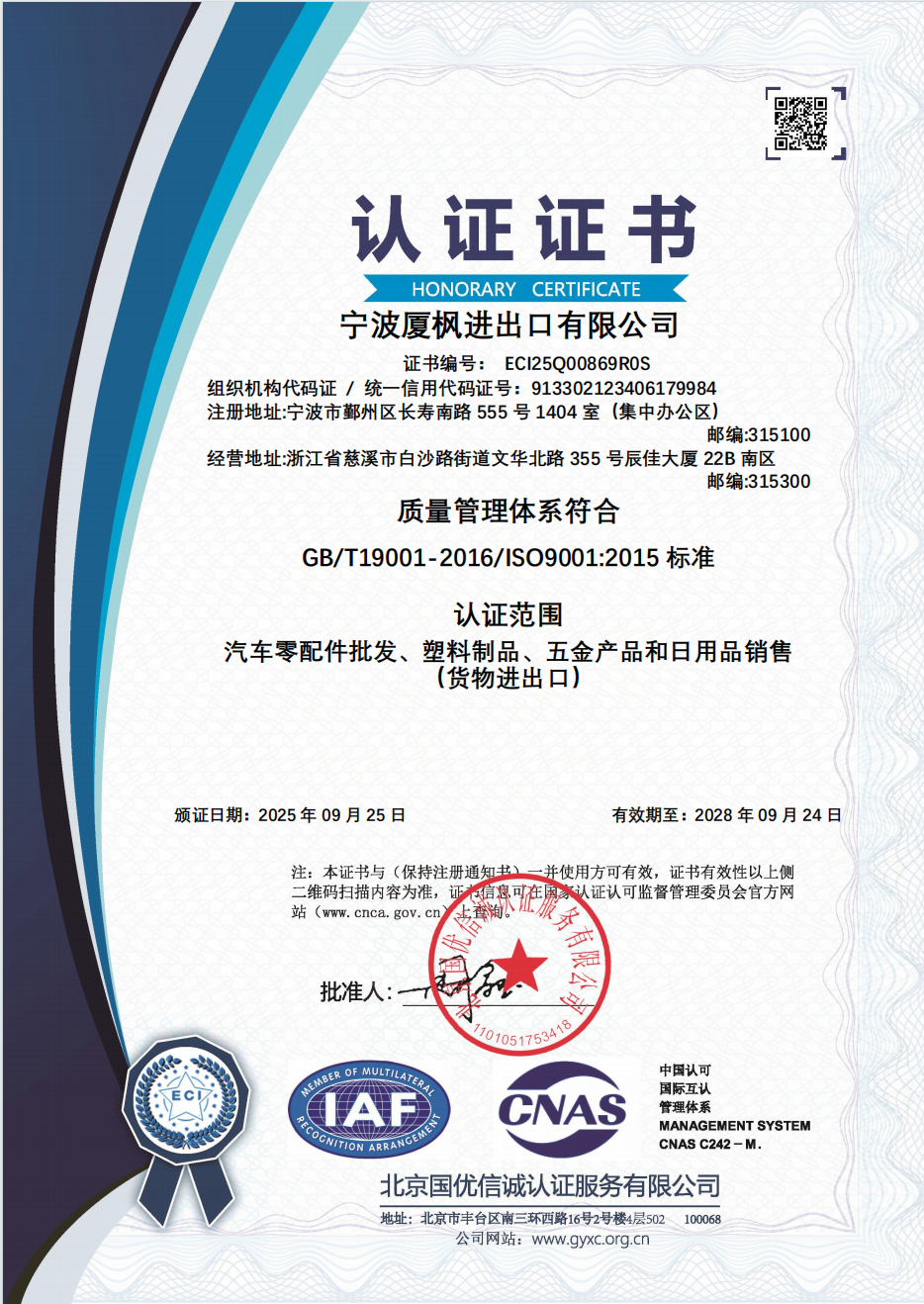
Quality Management System certificate ECI25Q00869R0S — a company-level certificate, not a product performance rating.
Two documents are commonly offered in this category, and each answers a different question. Reading their scope lines correctly is part of QC, because the wrong document in a customs file is a delay, not a reassurance.
ISO 9001 — certificate ECI25Q00869R0S. Issued on 25 September 2025 by Beijing Guoyouxincheng Certification Service Co., Ltd. against GB/T19001-2016/ISO9001:2015, valid until 24 September 2028. The stated scope is the wholesale of auto spare parts, plastic products, hardware products and daily necessities sales, including import and export of goods. What it supports: a documented management system covering sourcing, inspection and traceability at company level — the framework in which in-production and pre-shipment inspection sit. What it does not do: it is not a product certificate, and it says nothing about a specific rack's load capacity, coating thickness or corrosion performance.
RoHS — verification BCTC2507407245C. A Test Verification of Conformity issued on 21 July 2025 by Shenzhen BCTC Testing Co., Ltd. for the EU market, tested against IEC 62321-3-1:2013, IEC 62321-5:2013, IEC 62321-4:2013+AMD1:2017, IEC 62321-7-1:2015, IEC 62321-7-2:2017, IEC 62321-6:2015 and IEC 62321-8:2017. Its stated scope is a water dispenser, trademark Redsack, test model SP-03. The same record appears in the product documentation listed in association with the rack models SF-BR-01A (foldable) and SF-BR-11A (vertical).
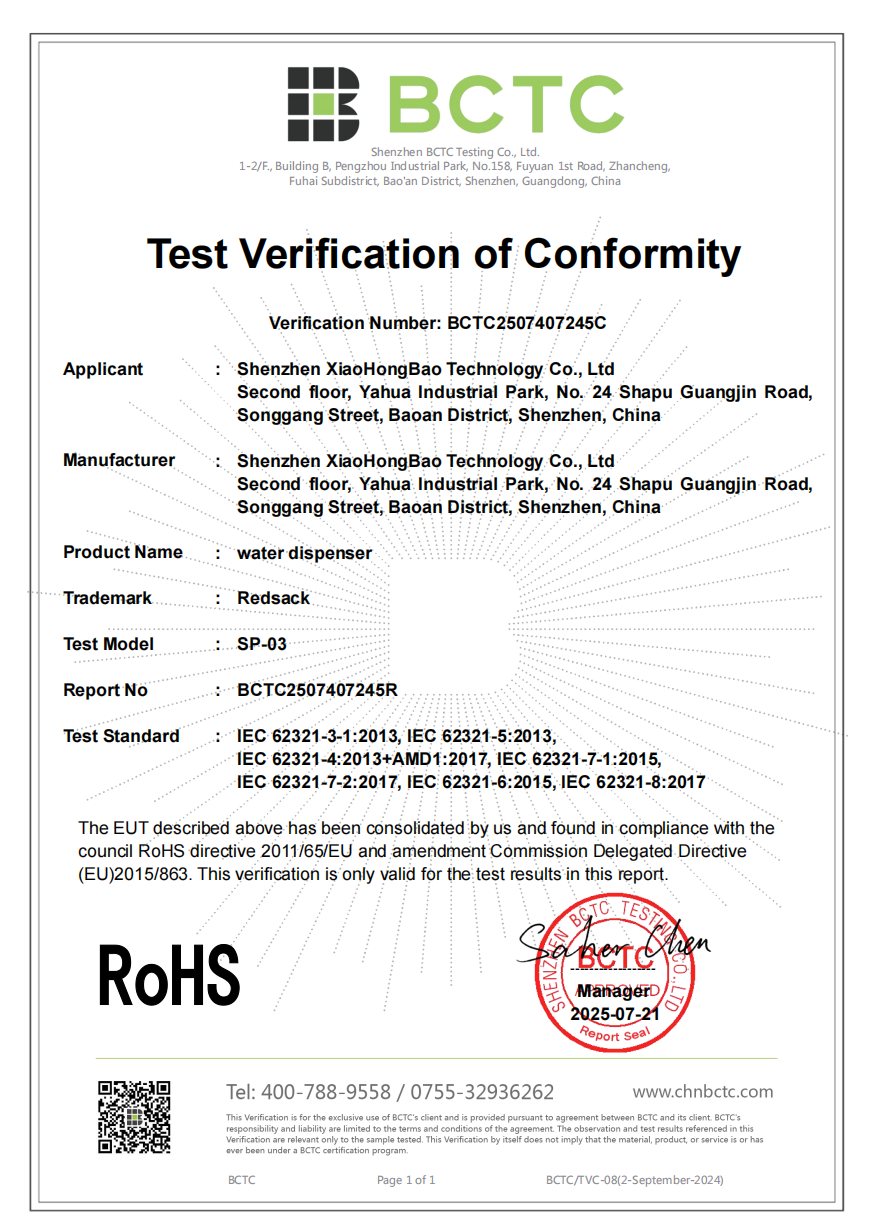
RoHS verification BCTC2507407245C — the scope line names the tested model and materials, so it must be matched to the ordered item.
That distinction is the whole point of a document check. A test verification is written against the tested model and the materials inside it. When a document is listed in association with a rack model, confirm in writing which model, revision and finish it is intended to support, and whether your destination market requires additional product-specific testing. This is not a criticism of any supplier; it is the same question your importer's compliance team will ask before the container clears.
Seven steps from approved sample to released order
The sequence below converts a sample decision into a lot decision. Each step produces a record, and the records are what make a claim defensible if something goes wrong.
- Retain and seal the golden sample. Keep at least two units: one sealed and labelled with date, model, finish, tube specification and order number; one kept accessible for handling comparisons. A sample that has been repacked repeatedly stops being a reference.
- Turn the sample into a written inspection standard. List dimensions, tube and wire section, finish criteria, hardware count, instructions, carton dimensions and sets per carton. Where the order is customised, this is also the point at which drawings and samples are confirmed before bulk production.
- Confirm pre-production documents. For OEM work the inputs are product type, quantity, target market, colour, logo, packaging requirement and any specific dimensions — all confirmed in writing before the run starts.
- Inspect in production. Run a first-article check at the start of the run against the golden sample, then repeat checks through the run so a drift is caught while it can still be corrected.
- Inspect before shipment. The standing checklist in this category is quantity, tube and wire specification, surface finish with no rust and no scratches, weld integrity, faucet or accessory assembly where applicable, packaging and shipping marks.
- Verify packaging volume. Measure cartons, count sets per carton, calculate CBM per set, and compare with the quoted assumption before the container is loaded.
- Release or hold, with reasons recorded. A pass should reference the checklist, the photo log and the measured carton sheet. A hold should name the specific control point and the corrective action.
Timing is part of the plan. Stock items can ship within five days at MOQs of 200–300 pieces, which leaves little room for a re-inspection loop; OEM orders run about 15 days at a 500-piece MOQ, and ODM orders about 30 days at 1,000 pieces, which allows a first-article check and a pre-shipment check to be scheduled properly. Book the inspection window when you place the order, not when the goods are packed.
Where this plan matters most
- Water delivery and distribution. Repeat orders make lot-to-lot consistency the real product; packaging volume also drives freight per unit on every container.
- Private-label brands. Logo, colour and packaging are part of the SKU, so completeness and finish are brand risk, not cosmetics. SHAFON describes a private-label customer running 2×40HQ per month whose stated requirement is structured product inspection, packaging confirmation and shipment preparation.
- Hotel and catering suppliers. SHAFON describes a hotel and catering buyer ordering 1×40HQ every two months, with attention to capacity, materials, packaging and spare-parts details — the same four control points in a different order of priority.
- Importers and one-stop sourcing programmes. Mixed product and accessory orders need one inspection standard that covers racks, faucets, caps and bases together.
- Home and office retail. Cosmetic finish and one-piece assembly dominate, because returns in this segment are usually about appearance and setup, not load.
Pre-shipment checklist: the one-page version
| Control point | What to measure or count | Record to keep |
|---|---|---|
| Quantity | Cartons per SKU against the packing list | Signed carton count |
| Section | Tube or wire outer diameter and wall thickness at defined points | Caliper readings vs sample |
| Finish | Side-by-side with the retained sample under the same light; bare spots, runs, rust, scratches | Photo log and pass/fail per unit |
| Welds | Tier-to-post joints, incomplete fusion, spatter | Photos of sampled joints |
| Stability | Loaded check on a level floor; rocking, foot contact, permanent deformation after unloading | Photo sequence or short video |
| Completeness | Hardware count per set, instructions, parts per flat pack | Count sheet against bill of materials |
| Packaging | Carton L×W×H, sets per carton, CBM per set, marks, moisture protection | Measured carton sheet |
Conclusion: keep the sample, document the lot
The sample did its job when it won the order. It only does its second job — protecting the order — if it is sealed, labelled and turned into written acceptance criteria that the factory and the inspector both work from. Four control points cover the places where bulk 5-gallon water bottle racks most often drift: finish, load and structure, assembly completeness, and packaging volume. Two documents cover the paperwork side: a company-level ISO 9001 system certificate such as ECI25Q00869R0S, and a product-specific test verification such as BCTC2507407245C, each read against its stated scope rather than its logo.
Once the checklist exists, releasing an order becomes a decision backed by records instead of a hope based on one unit. Buyers who want to compare a candidate model against these criteria can download the SHAFON product and quotation brochure at Quotation of Smart Water Solution and review the rack range on the SHAFON Water Solutions website.
Frequently asked questions
Which certification documents apply to a 5-gallon water bottle rack order, and what does each one cover?
ISO 9001 certificate ECI25Q00869R0S is a company-level quality management system certificate issued on 25 September 2025 by Beijing Guoyouxincheng Certification Service Co., Ltd. against GB/T19001-2016/ISO9001:2015 and valid until 24 September 2028, with a stated scope covering wholesale of auto spare parts, plastic products, hardware products and daily necessities sales including import and export of goods. It supports management-system claims, not individual rack performance. RoHS verification BCTC2507407245C is a Test Verification of Conformity issued on 21 July 2025 by Shenzhen BCTC Testing Co., Ltd. for the EU market against the IEC 62321 series, and its stated scope is a water dispenser, trademark Redsack, test model SP-03; the same record appears in the documentation listed in association with rack models SF-BR-01A and SF-BR-11A. Because a test verification is written against the tested model and its materials, confirm in writing which document, revision and model apply to the rack and finish you are buying.
What information is needed to quote an OEM 5-gallon water bottle rack with custom dimensions?
SHAFON lists the required inputs as product type, order quantity, target market, rack colour, logo, packaging requirement and any specific dimensions, with drawings and samples confirmed before bulk production. Commercial terms are separate: OEM orders carry a 500-piece minimum and roughly 15 days lead time, ODM development runs at a 1,000-piece minimum with about 30 days, and stock items can ship within five days at 200–300 pieces. Sending dimensions, drawings and target market together shortens the quotation round.
How should a buyer evaluate the load capacity and structural stability of a water bottle rack?
Check four measurable things: tube or wire diameter and wall thickness (quoted examples include 16×0.8 mm wire and 20×20×0.6–0.8 mm steel tube), weld quality, base width and tier count. SHAFON states that product drawings and loading references can be shared on request. As a scale reference, a full 5-gallon bottle weighs about 42–45 lb, so a 12-bottle rack carries roughly 500–540 lb of product — a calculated figure, not a rated capacity. If a supplier quotes a load rating, ask for the test method and safety factor behind it.
Are water bottle racks supplied assembled or knocked down?
It depends on the model. Foldable types ship flat, packed in an OPP bag or on a paper card, while one-piece types ship assembled in individual boxes; both are set up easily on arrival. For inspection this means completeness has to be checked at two levels: hardware count per set against the bill of materials, and units or sets per carton against the packing list. Instructions and small fittings are the items most often found missing after a container is opened at destination.
What is the difference between powder-coated and chrome-plated water bottle racks?
Powder coating offers broad colour options and good surface protection when properly applied; chrome plating gives a bright metallic appearance. Corrosion performance for either finish depends on substrate preparation, coating or plating quality and thickness, and the service environment. In practical QC terms, powder-coated racks are inspected for colour and gloss against the sample, coverage at welds and cut ends, runs and chips to bare steel; chrome-plated wire is inspected for brightness uniformity, pitting, yellowing and coverage inside the bends where plating is thinnest.
How can foldable rack design reduce packaging volume and ocean freight cost?
Foldable racks pack flat at about 30 sets per carton, roughly 60–70% less shipping volume than one-piece racks, which reduces ocean freight cost per set. The saving has to be verified rather than assumed: measure carton length, width and height on a sample of cartons, count sets per carton, calculate cubic metres per set, and compare that figure with the volume assumption used in the quotation. A slightly taller carton or fewer sets per carton raises freight per unit even when every rack inside meets the sample.
What if the bulk order quality differs from the sample?
The controls are structured in-production inspection, pre-shipment inspection and a packaging confirmation made per order, all measured against a sealed retained sample. In practice that means a written checklist, a first-article check at the start of the run, a pre-shipment check of quantity, tube and wire specification, surface finish, weld integrity, accessory assembly, packaging and shipping marks, and a recorded pass-or-hold decision before the container is loaded. Buyers planning a first or repeat order can send the model (for example SF-BR-01A, SF-BR-11A or SF-BR-20A), quantity, target market, finish and packaging requirement to SHAFON at azhang@shafonwater.com to arrange a sample and an inspection plan that matches the order.
Have Questions or Need More Details?
Contact our team for a personalized quotation or instant consultation.
Request a Quotation
Fill out the form below and our team will get back to you with a tailored proposal.
WhatsApp Direct Chat
Prefer to chat in real-time? Message us on WhatsApp for instant assistance & quick answers.
- Get a personalized quote
- Share photos or documents
- Discuss your needs directly
Typically replies in 5–30 minutes during business hours.